
Assessment Portfolio: Defined
What is an assessment portfolio?
Developed with material generated from ChatGpt. OpenAI. (2023). ChatGPT (3.5 version) [Large language model]. https://chat.openai.com/chat
An assessment portfolio is a purposeful collection of evidence that showcases an individual's or a group's achievements, skills, knowledge, and experiences in a particular area. It is often used as a comprehensive and dynamic assessment tool in educational and professional settings. The contents of an assessment portfolio can vary depending on its purpose, but they typically include a variety of artifacts, such as:
-
Work Samples: Examples of the individual's or group's work that demonstrate skills and competencies.
-
Reflections: Personal or group reflections on the learning or work experiences, providing insights into the thought processes, challenges, and growth.
-
Artifacts: Any tangible items or digital media that represent achievements, projects, or accomplishments.
-
Assessment Tools: Results from formal assessments, tests, quizzes, or evaluations related to the specific area being assessed.
-
Certificates and Awards: Recognitions, certificates, or awards received for achievements in the field.
-
Resumes or Curriculum Vitae (CV): A summary of qualifications, experiences, and achievements related to the assessment focus.
-
Feedback: Comments and feedback received from peers, mentors, instructors, or supervisors.
The purpose of an assessment portfolio is to provide a holistic view of an individual's or group's capabilities and growth over time. It is often used in educational settings to assess student learning, in professional contexts for employee evaluations, or in personal development to track and reflect on one's own progress. Portfolios can be physical or digital, and the format may vary depending on the context and the goals of the assessment.
Development
Required Components About Me/My Story: 200-300 words. Your goal is to offer your "story." This might include achievements; obstacles; and personal interests. Your “story” should include descriptive language and concrete examples to engage the reader. You may include photos of yourself and/or interests; button or link to resume or CV; and contact email, if appropriate. All elements, including text and images, should enhance your ethos or image as a future professional in your chosen field. Philosophy/Personal Statement: 500 word statement of your identity and perspective within your field. Strengths and Skills: identified through HighFive or Clifton StrengthsFinder (such as leadership, collaboration, empathy, perseverance, or organization); discussion may also include individual interests that illustrate you as a unique soul (musical ability, study abroad, language proficiency, physical fitness, or reading interests). Summarize each strength/skill; illustrate how this strength is shown through your academic work, life experience, work history, and/or individual interest; when possible, provide a tangible representation of this strength/skill through an artifact; finally, connect this strength/skill to your future profession. Provide artifacts and images whenever possible to prove and illustrate your claims and embed your artifacts within the text or provide separate buttons alongside text. Additional Artifacts – at least one in each area Academic Achievements (and Interests): includes degrees; honors; scholarships, with explanations as necessary; for newer students, this discussion may focus on interest areas and academic goals and objectives. Artifacts providing examples of specific achievements could include papers, speeches, projects, posters, photographs, videos, and artwork; artifacts can be embedded within your text or provided as separate buttons alongside text; you may also choose to embed resume or CV here. Work Experience and Service: include related experiences, both paid and unpaid, and explain how this experience enhances your preparation as a future professional. Include photos when applicable, and highlight longer or informative experiences as you wish. The above pages/tabs should be easily accessed from your home page, but they can be organized as individual pages or in appropriate cascading design.
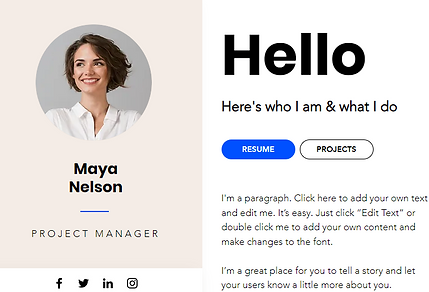
Sample Portfolio Templates

Privacy
Keeping Your Wix Site Private There are three main ways to keep your site private on Wix. You can unpublish your site, password-protect pages, and hide your Wix site from search engines.